
How to Fix Your Ankle Sprain

You rolled your ankle. People say “its just an ankle sprain”…..and then they keep rolling them over and over again. Here’s 4 key tips to keep you from becoming a statistic, and get back out there crushing it!
Today we’ll discuss:
what is an ankle sprain?
how do I get motion back?
What compensations cause repeat sprains?
Why you should train your ankle through full motion.
A note for the lawyers: none of this is to be taken as individual-specific medical advice. Its general information to guide your process and actions. If you have an ACUTE injury, or have additional questions, please seek the help of a trusted medical professional. Also, it IS possible that your Ankle sprain isn’t actually an ankle sprain at all -sometimes the bone cracks off instead. That’s why we have medical imaging - so you can check and know what’s going on! Be your own best friend and seek help when needed. Ok, with that out of the way, let’s actually get to work.
What is an Ankle Sprain?
and why do they keep occurring ?
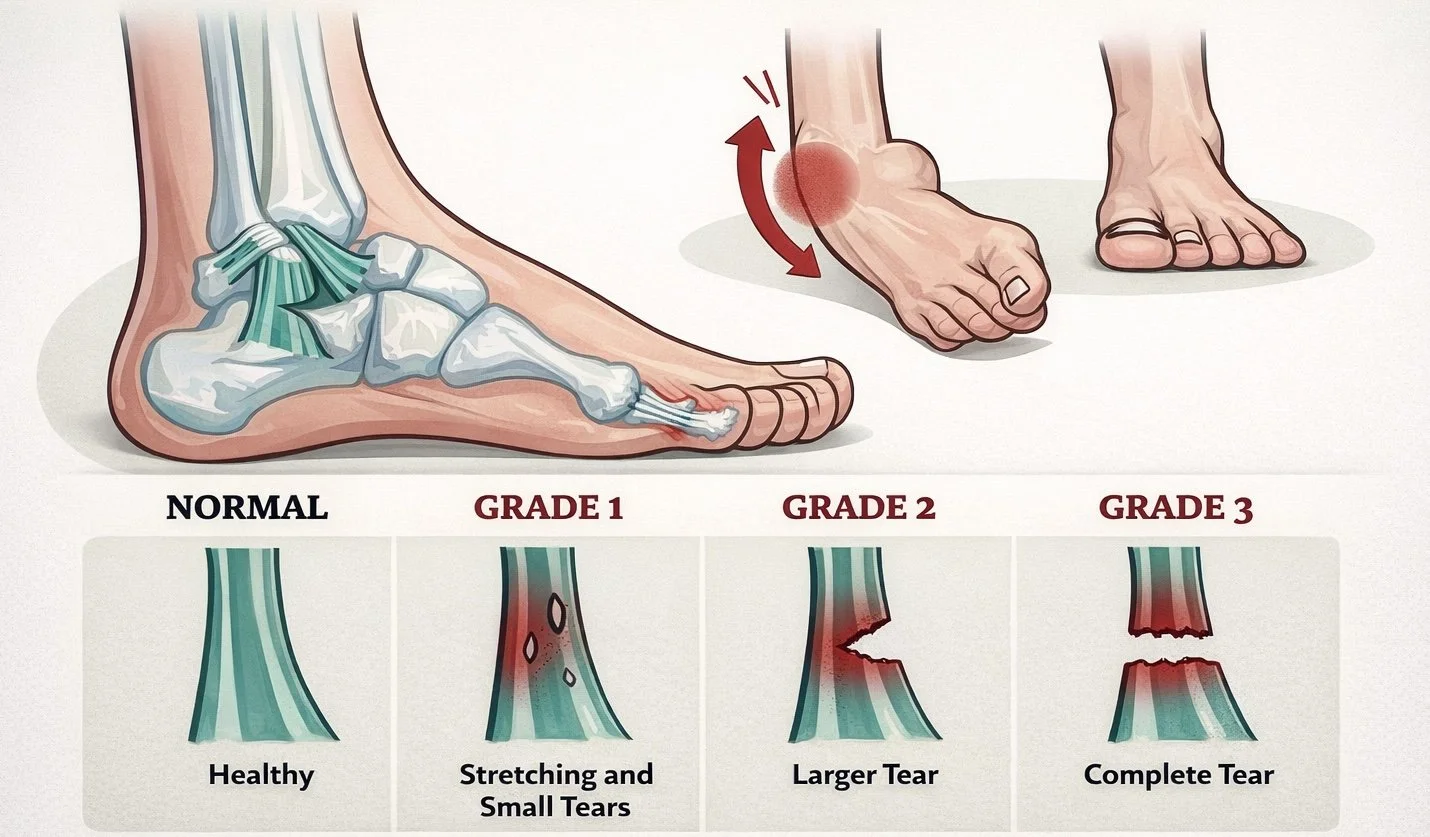
Ankle Sprain Grades: Ligaments are somewhat like seat-belts - they connect bone to bone to help things in position. But sometimes they get overloaded and can tear. A “sprain” is a tear of the ligament. We assign grades 1-3 to indicate severity of the tear.
Ligaments are bands of connective tissue that keep your bones in place and dynamically aligned as you move. When you sprain a ligament, you literally tear it. We can GRADE these tears as a grade 1,2,or 3. Grading the severity of an ankle sprain is something best left to a health professional, and not something to ask Dr Google. Why? Its funny…..when people tear their ACL (a major ligament in their knee) all hell brakes loose. But when people sprain their ankle, they say, oh, its just an ankle sprain - I’ll be back out there in 3 days. Well…..this plan likely won’t work. And in fact, a LOT of you (about 45-65%) become chronic sprainers - you sprain your ankle multiple times a year, month, or even week. What’s going on?
Ligaments in your ankle WILL heal —> If you tore your ligament as in the pictograph above, research shows the ligamentous fibers will heal to about 97-98% of the pre-injury strength. (note: some grade 3 tears will require surgery to approximate the tissue so it can heal back together) But even in the face of surgery, the ligaments heal really well, and actually the PASSIVE integrity of the ligament itself is NOT the problem.
Ligaments Aren’t Just Passive
They FEEL
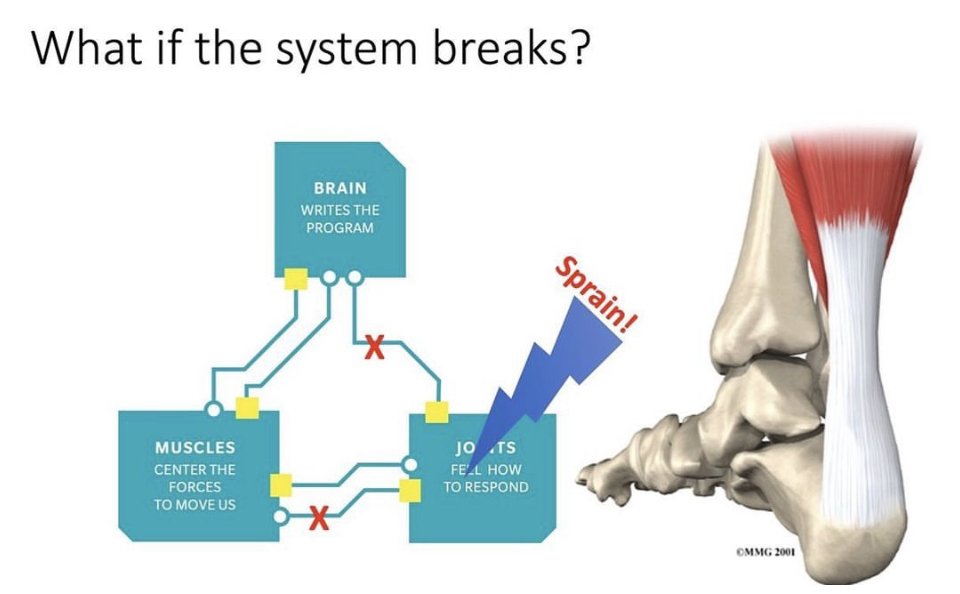
Apparently 75% of of you actually read these newsletters, and if you are one of those, you’ve read me talk about PROPRIOCEPTION multiple times. Its likely the coolest sensory system in your entire body. And fun fact, its actually the FASTEST sensory system in your entire body.
Proprioception is the ability for you to tell where you are in space. Imagine this - you just got the mail and are walking back to your house on the side walk. You are reading a letter and not really paying attention. Your foot lands right over a 2in crack in the sidewalk. In this scenario:
someone with GOOD proprioception would sense this irregularity and before they even had time to think, their body would reflexively make a correction to the position and control in your ankle and and you get into your house safely.
someone who has sprained their ankles has a different story. Your ligaments have SENSORY fibers that give your body INPUT to help with proprioception. While the ligaments strength does heal pretty close back to normal, the nerve fibers you tore don’t heal. Your joint lost the ability to FEEL where you are and respond. So while you stumble over that crack in the pavement, your body can’t FEEL the change in position, and your ankle rolls outward yet again….causing yet another sprain.
The next 3 things we’ll cover will help you get your motion back, and build control so you don’t become a statistic. Keep reading…..I’ll show you how this process actually works!
2. Getting Motion Back After an Ankle Sprain
Waking, running, cutting, and jumping require your ankle to bend forward (called dorsiflexion) and “step on the gas” (called plantar flexion). Dorsiflexion is a “safe position” - the joint surfaces have lots of contact and can’t roll outward into a sprain. But after an ankle sprain, a LOT of you (>80%) will lose your dorsiflexion motion. And you REALLY need to get this back.
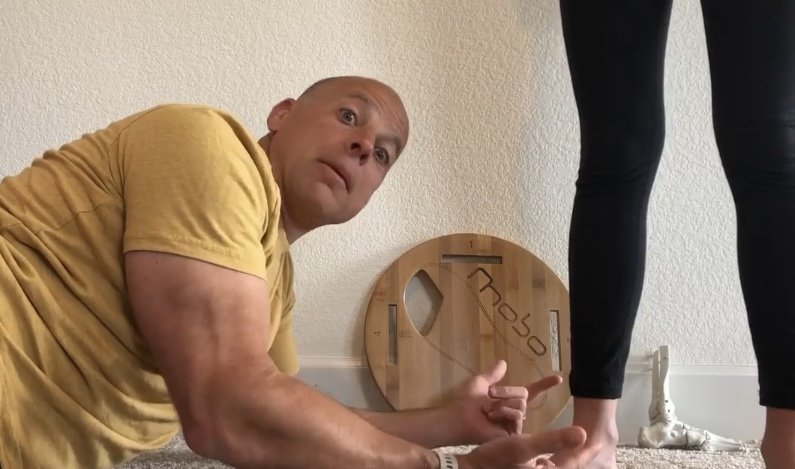
I made a 3 video series on how you can assess and mobilize your ankles to get your motion back. Yes, I know this takes time, but it’s FREE and if you are someone who has ankle stiffness, you REALLY need to do this! Be proactive and please watch these in order:
3. Stop Compensating
So what if I told you that holding your body in a certain way would literally create an injury. A rational person would (hopefully) make the effort to NOT do that.
The way you sprain your ankle is to plantar flex and invert it. Think stepping on the gas and twisting your foot inward at the same time. That’s the exact position you want to AVOID. But research studies I’ve been involved with show*:
Joint position is altered in people with ankle sprains.
Balance is altered in people with ankle sprains.
The people who sprain once and keep spraining are classified as having “Chronic Ankle Instability”. And our research shows that they keep their ankles plantar flexed and inverted all the time - even when the leg is swinging through the air. This is the EXACT position they should avoid, but they can’t feel it (remember, those nerves are torn!) This is not a ligament strength problem, but a proprioception problem.
But there’s good news!!! Your body is pretty awesome. The nerves in your ligaments aren’t the only way for your body to FEEL and SENSE where it is. You have redundant inputs to your nervous system that we can tap into through moving. That’s right - your body can LEARN through moving. Step 1 is to fix your compensation in staying plantar flexed and inverted by overcorrecting and FEELING that you can move into EVERSION.
To fix this you are going to train with your MOBO fins in the OUTER slots. this is going to force you to put your foot into an EVERTED position. I’ve got a really nice view for you HERE.
References:
Herb CC. et. al. Shank-rearfoot coupling with ankle instability. Journal of Applied Biomechanics.
Chinn, L., et.al. Ankle kinematics of individuals with chronic ankle instability while walking and jogging on a treadmill with shoes.
Chinn, L., et. al. Gait kinematics after taping in subjects with chronic ankle instability."
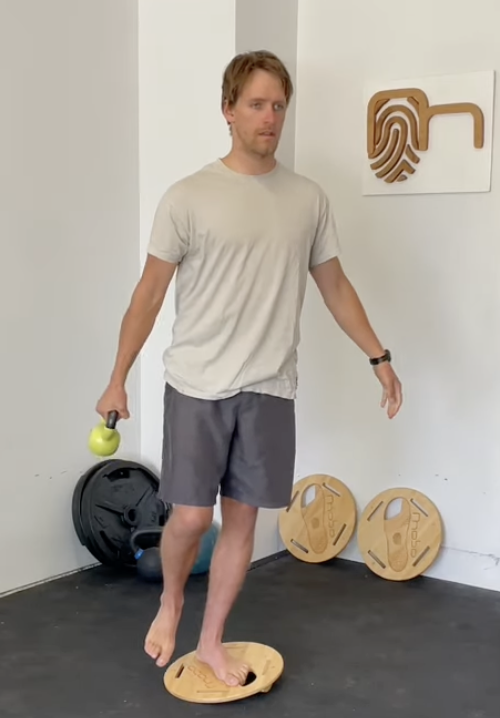
Everted Pass Around
Fins in OUTER slots. Grab a 5-10 lb weight, or a water bottle. And pass it from left hand to right hand, and back again for 2 min.
Note: this exercise will not help you become the #1 US slalom skier like Tommy Ford on the left.
4. Why you need to train through full range of motion
Can we talk about pet peeves for a second please? If you hurt a joint, or the muscles or connective parts around the joint - ANY JOINT - a MAJOR part of rehab is learning FULL CONTROL through the joint’s range of motion. This rule applies to EVERY JOINT in the body. Period. Yet, for some reason, there’s a number of “experts” and “fitness influencers” on social media saying that you just need to train the foot and ankle on flat ground. This is like saying we only need to train our core, shoulders, spine, hips, and knees in ONE position to get us through everything we need to do. I’m sorry, but this is A) incorrect, and B) doing a major disservice to the people we are trying to HELP! Please STOP.
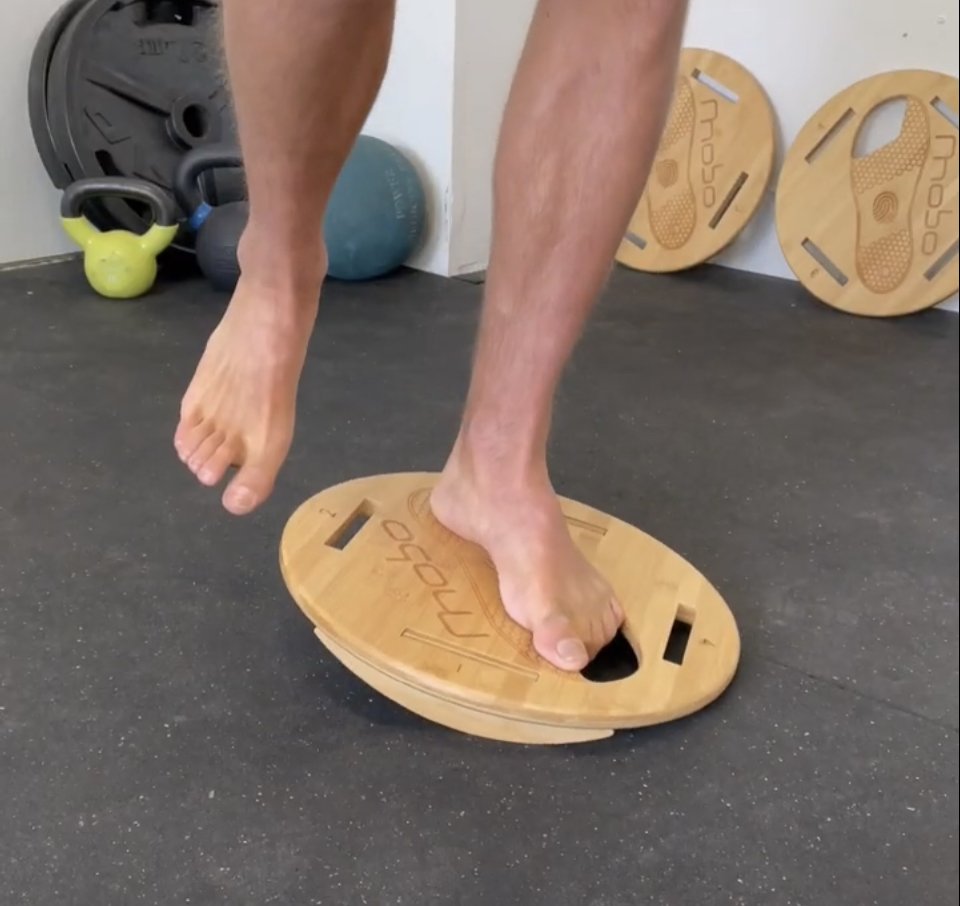
Feet + Ankles MOVE. And we need to train them for the load and movement they’ll see in the real world - not just drawing an alphabet in the air with your toes. You’ll notice that the MOBO rocks back and forth - Exactly 15 degrees in each direction. The reason I specifically designed it to rock 15 degrees is because:
15 degrees is plenty of motion to train weight bearing inversion and eversion - its actually more range than your ankle goes through in the load-bearing phases of walking and running.
15 degrees is pretty safe. Even if you are on the acute side of a ligamentous tear, 15degrees is a joint friendly amount to rock back and forth. And if you ARE concerned that it is too much for where you are currently in your rehab, you can place a book under one side of the board to block/reduce the tilt.
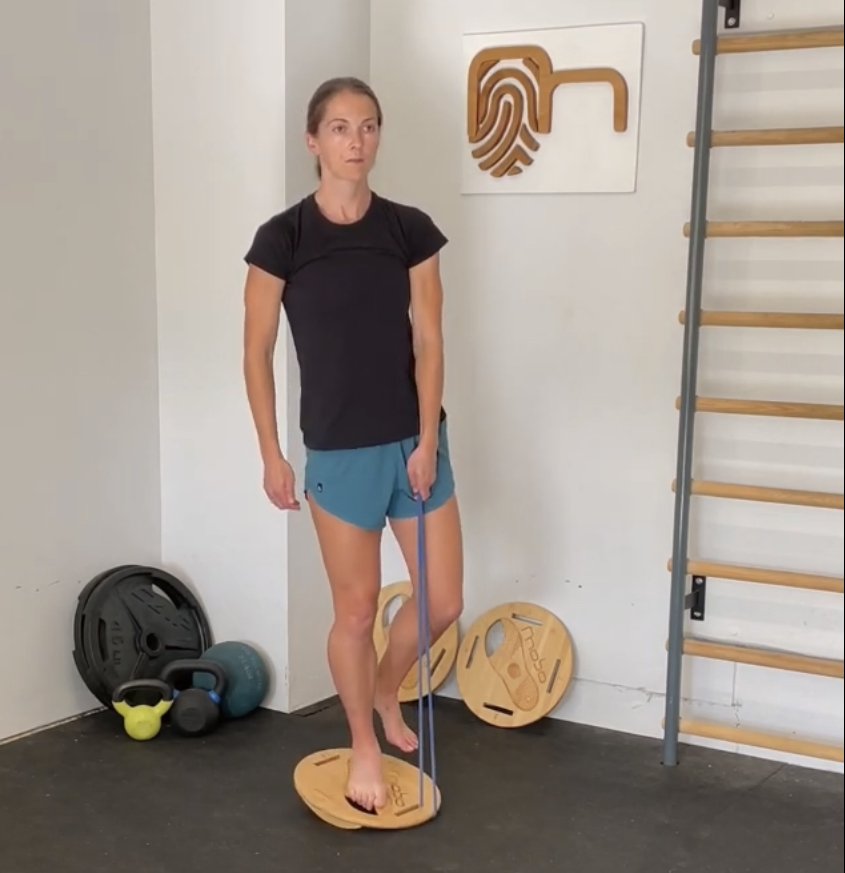
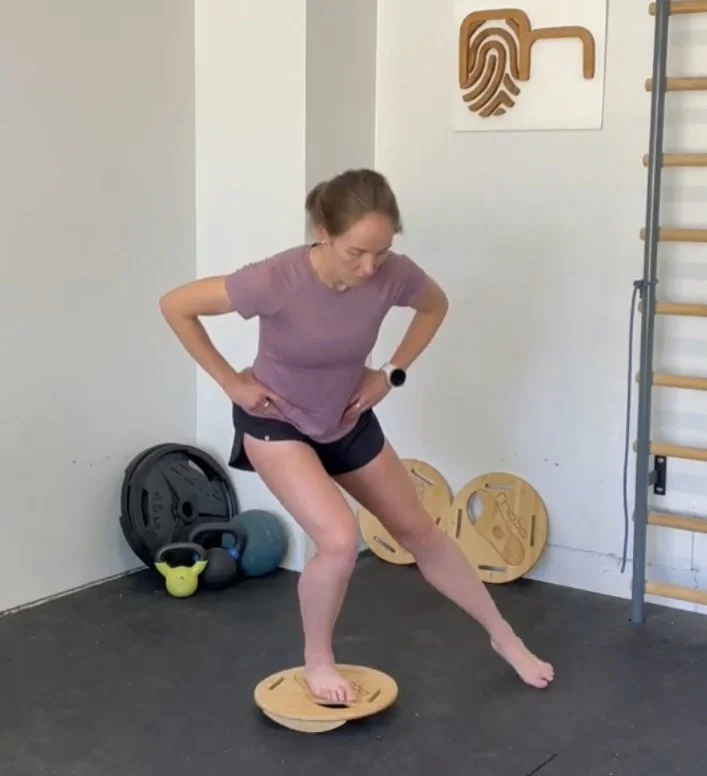
So in addition to the EVERTED PASS AROUND above, here’s my other top 3 exercises for people with ankle sprains:
Foot Rocks
Star Squats
Banded foot Rocks
These 3 moves train you to move through FULL range of motion in the foot and ankle, and also train you to load your dorsiflexion while stabilizing. Videos of each are on our SITE If these seem too hard, please check out the regressions section by clicking on the FOOT in the interactive body on our SITE.
The tips above are by no means an exhaustive list of all the things one should do during or after an ankle sprain. but if you are someone who says “I got better, but I just keep spraining” - these tips above have produced better outcomes than anything else I’ve ever done with my own patients, and can help other as well. Wishing you all the best!