
Super Shoes! Do They Work?
Unless you live under a rock, you’ve likely heard of these “super shoes” that the elites and fast kids are wearing. As you think about your own place in history as a runner, you may be wondering if you too could benefit from something a bit more special underfoot.
I think about this stuff too, because hardly a week goes by without some media company asking me questions about this revolution in shoe technology. The shoe industry claims one thing, the rumor mill says something else, and the research is just starting to find out some pretty interesting stuff…..In my “other job” I work with a lot of footwear companies over the years doing both validation and innovation testing. And I’ve worked with elite athletes that have had these shoes since the inception (before they were for sale). Combine those 2, and I have a lot of insight to share, and want to ensure you get the RIGHT guidance.
So what’s so special about these shoes? How do they work? Is it all smoke and mirrors? (Science does tell us how these shoes work, and it’s actually WAY simpler that the marketing geniuses at _____ company will lead you to believe). Is some of this placebo? A great study by Kim Hebert-Losier shows us that yes, there’s certainly some mental gymnastics that we can’t ignore.
Sports Tech is Pretty Cool.
But It Changes Things.
As a young swimmer, I remember when the speedo speed suits came out. Elite swimmers started wearing them, and records started falling. And then we got into an interesting discussion about the limits of tech in sport. Was it about the SWIMMER? or was it about the SUIT? These new Speedo suits featured an ultra-low drag coefficient that was actually slipperier than skin. If you had the money you could literally BUY your way into a faster swim time. Was that ethical?
As a young cyclist, I remember when Greg LeMond first used a pair of funny looking aerobars on his bike in the Tour de France - that produced an aerodynamic position, and enough of a boost to his performance that he won the time trial stage, and won the entire Tour de France. And the media went nuts with the same argument….Did Greg win, or did the aerobars win? should they be allowed?
As a runner, these funny looking bouncy things started showing up quietly at the doorsteps of elites. As a researcher whose been testing shoes for years, all previous cushioning based footwear did just fine. It may have shifted things a fraction of a % up or down, and lighter weight materials certainly helped, but nothing was really FASTER. But these super shoes were different. Buzz started happening….Times were falling. And talk of a sub 2 hr marathon in funny shoes was all the rage. And now anyone with an obscene amount of $$$ in their wallet can walk in and buy them off the retail wall.
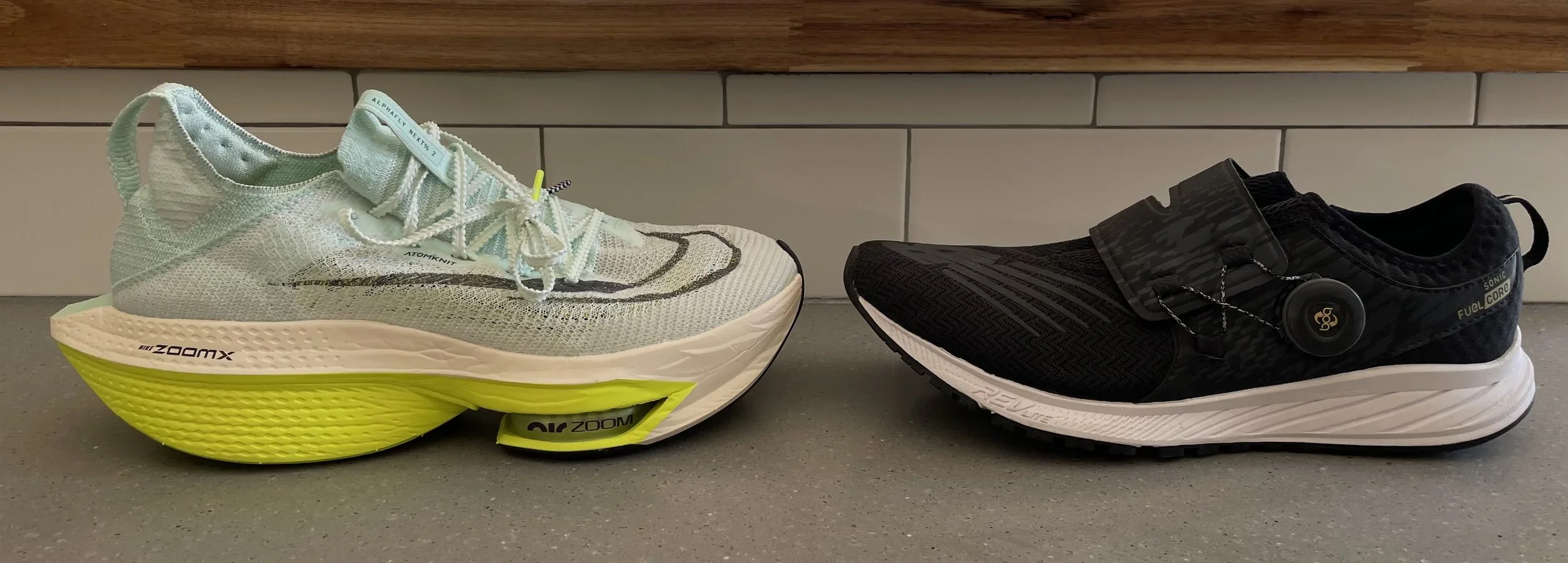
These 3 technological advances certainly WORK. As in, they create a performance advantage. But with any technology revolution in equipment, comes a reckoning. The swimming world federation decided that a suit that was more slippery than skin was an unfair advantage. And they banned competition swim suits that were beyond a certain drag coefficient. The cycling world met to decide what events they’d allow aerobars and the new aerodynamic bike geometries, and which ones they’d impose restriction. Well, this has now happened in running as well.
Ever since these shoes burst onto the scene, there’s been a LOT of speculation, rumors, and flat out misinformation. These days if you an elite, and don’t show up wearing them at the startling, its like showing up handing seconds to your competitors. Likewise, there’s a number of runners who have gotten hurt running in them. And there’s a bunch of people who have the financial means to buy them, but that will barely get any boost in performance at all (watch the video to see why). And are $350-400 shoes equitable, especially in youth runners? The time to speculate ends now.
The TRUTH on Super Shoes
Its time to learn the truth about these shoes. I made a little video I hope you enjoy to help you understand this technology, and see if its right for YOU and your goals. In this video we’ll cover:
Cushion + Compliance: What’s the difference?
Springs, Stack Height, and Trampolines
Tuning Shoes
Springs, Direction, and Instability
Effect on running form and injury
To see “A Masterclass on Super Shoes for Runners”, click here. I tried to distill down some complex topics into some really simple visuals and animations, and you even get to see me jump on a trampoline and my kids jump on a pogo stick. Totally FREE. Hope you enjoy it!
Do Super Shoes Cause injury?
This is an interesting - and critical question. As with anything, we look to both research studies and observational real world and clinical scenarios. Some new research studies have shown that super shoes (also called AFT - Advanced Footwear Technology) does not cause injury:
Arndt + colleagues showed rough equivalent injury risk for AFT and non-AFT shoes
so what’s the answer?
Driving YOUR Car Fast vs
Driving a RACE Car Fast
Lots of people think they are really great drivers. And you may in fact be a good driver. I have 2 friends that are likely better than you. One was a professional Can-Am racer for over a decade. My other friend was a professional rally racer, and jumped his car over a 75 ft gap in the X-games. They have skills you don’t.
One of my friends let me drive his rally car. It was 575 hp in a shell of a car weighing roughly 2000 lbs. For context , that’s about 2-3X the power in your typical performance sedan with half the weight. While it was one of the most fun things I’ve ever done, there is a VERY STEEP learning curve driving that car. The race harness, 2 clutches, torque distribution knob, suspension, traction, and raw POWER were insane. It was NOTHING like driving anything I’d ever driven prior, and to be transparent- I was horrible at it. While that car could jump a 75ft gap, I could not pilot it to do so. I had to recalculate literally everything I knew about driving, because the car was so….different.
If you are still with me- that’s the way I hope you think about super shoes. The shoes aren’t “good” or “bad” - but it's a totally different environment that takes a while to to get used to.
And then there’s real world impact: None of those studies above matter to 2 runners I worked with who got a pair of these shoes from their sponsors a few weeks before Olympic trials. This was 2 Olympic cycles ago, and these shoes were poorly understood. Both were prior Olympians, super fit at that time of year, and their Olympic bid was theirs to loose. Unfortunately, both got injured immediately after racing in them ONCE, and missed their chance to return to the world stage. And these above studies don’t matter to the coach of a powerhouse D1 program that kept his runners out of supershoes up until a few months ago. Well….he finally caved, and within 4 weeks half his team was injured. I got a call with a plea to help.
Again, I’m not saying that it was the shoes that caused the injury, but rather the shoes are SO DIFFRENT that the stresses on the runner change. A LOT. Your body can adapt to a lot as well, but its needs to be GRADUALLY and with INTENTION. Your shoes aren’t causing your injury. Your lack of preparation and resilience is creating your injuries. Yes, I know, the truth can hurt. But I’d rather it hurt your ego for 30 seconds than have you hurt your body for weeks…. or months.
What Side of This Are You On?
Look- I’m not here to change your bias and your mind. I’m only on one side- YOUR SIDE.
The reality is my phone rings when you get hurt. And I can confidently say that my phone is ringing more than typical since supershoes became more widespread. I don’t believe it’s the SHOES that are hurting you. But again every study has shown (please watch the video link to see the studies) that running in super shoes places DIFFERENT stresses on your body in a DIFFERENT timeframe. So then the question is NOT “do supershoes cause injury” - but rather “did you prepare your body to run in shupershoes?” 20 years ago I raced a half marathon in crocs on a bet. Not only did I finish in the top 10, but I was totally fine after. I consistently put in the work to be able to do what I wanted to do. That’s the way you actually PREPARE for the challenge ahead.As a physic, I’ve been training my foot and ankle health long before it was trendy on social.
To wrap this up - ask yourself if your are running to get ready for your next race - or actually PREPARING your body for the realities of your next race (in supershoes). If you are putting in your work on your MOBO to build a stable and strong foot and ankle complex, and GRADUALLY transitioning into your supershoes, you just might have a super run.